
Shelby County Dissolution of Marriage Records
Shelby County dissolution of marriage cases are filed at the Circuit Court in Shelbyville, Indiana, where Clerk Jill Lacy maintains the official record for every case from first filing to final decree, and this page walks you through how to look up those records, what you need to file a petition, and where central Indiana residents can find legal help during a dissolution.
Shelby County Quick Facts
Shelby County Clerk Office for Dissolution Records
All dissolution of marriage records in Shelby County are maintained by the Circuit Court Clerk in Shelbyville. Clerk Jill Lacy and her office receive new petitions, assign case numbers, keep the docket current through each stage of the proceeding, and store the signed final decree when the judge closes the case. Copy requests, case status inquiries, and questions about filing all go through this office.
| Clerk | Jill Lacy |
|---|---|
| Address | 407 S. Harrison St., Suite 114, Shelbyville, IN 46176 |
| Phone | (317) 392-6320 |
| Fax | (317) 392-6339 |
| jtaylor@co.shelby.in.us | |
| Hours | Monday-Friday, 8:00 AM - 4:00 PM (Eastern) |
| Website | co.shelby.in.us |
Suite 114 at 407 S. Harrison Street is the in-person location in Shelbyville. Office hours are Monday through Friday, 8:00 AM to 4:00 PM Eastern time. Try not to show up close to 4:00 PM if you need time to talk with staff about your case. Call the clerk at (317) 392-6320 if you have questions before visiting. Written requests and questions can go to jtaylor@co.shelby.in.us. Fax submissions are accepted at (317) 392-6339 for those who prefer not to come in person.
The Shelby County official website is the place to check for any updates to the clerk's hours or contact information. It is worth a look before traveling to Shelbyville, particularly around state holidays.

The Shelby County website at co.shelby.in.us carries the most current contact details for the clerk's office in Shelbyville and is updated when hours or staff information changes.
The Indiana Courts local directory for Shelby County lists judge assignments and circuit court contacts for dissolution cases in Shelbyville. It is maintained by the Indiana Supreme Court and reflects current court staffing.
Shelby County Dissolution Case Search Online
Indiana's free public case search tool, the Indiana MyCase portal, covers Shelby County and is the fastest way to look up a dissolution of marriage case without traveling to Shelbyville. Search by party name or case number. No login or fee required. You get case status, filing date, hearing schedule, and docket entries. It is the right first step when you need to find a case number, confirm a dissolution was finalized, or check what stage a case is in.
What MyCase does not give you: the text of the final decree, the terms of any property settlement, or sealed materials. For actual copies of dissolution documents from a Shelby County case, contact the clerk's office at Suite 114 in Shelbyville. Standard copies run $1 per page. Certified copies, needed for most post-dissolution tasks, carry an additional certification fee. The clerk can confirm current rates when you call at (317) 392-6320.
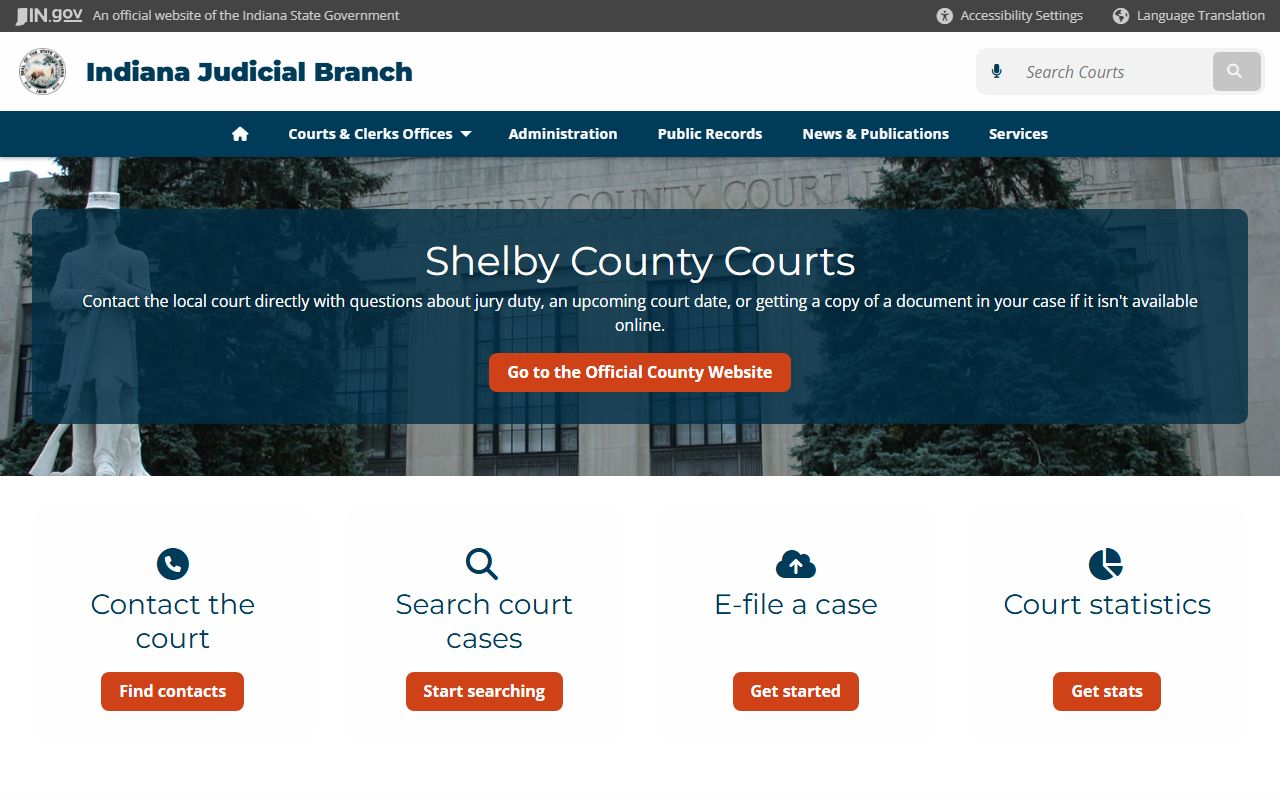
The Indiana Courts directory page for Shelby County is useful for identifying the correct court division and judge handling your dissolution matter at the Shelbyville courthouse.
Doxpop is a paid Indiana court records service that covers Shelby County and neighboring central Indiana counties. It is most useful for cross-county searches or when you need to dig into older filings that may be harder to surface in MyCase. Doxpop requires a subscription for full access, but some free searching is available on the site.
Mail your copy request to: Shelby County Clerk, 407 S. Harrison St., Suite 114, Shelbyville, IN 46176. Include the case number or both parties' full names, the specific document you need, whether you want a standard or certified copy, and a check payable to the Shelby County Clerk for the applicable fee. Allow extra time if the copy is needed by a deadline.
Filing Dissolution of Marriage in Shelby County
Opening a dissolution case in Shelby County starts at the clerk's office at Suite 114 in Shelbyville. You file a petition for dissolution of marriage, a summons, and whatever other forms your situation requires. Cases involving minor children typically require parenting plan documents and financial disclosures. Call the clerk at (317) 392-6320 before you come in to make sure you have the right forms for your situation.
Residency is a gating requirement. One spouse must have lived in Indiana for at least six months and in Shelby County for at least three months immediately before the petition is filed. Both conditions must be satisfied at the time of filing. If the county residency requirement has not been met yet, the case has to wait until it is. Filing too early will result in a dismissed or held petition.
Indiana is a no-fault dissolution state. The only recognized ground is irretrievable breakdown of the marriage. You do not have to show that anything specific happened or that either spouse was at fault. This is the standard in every Indiana county, including Shelby. The threshold for filing is low, but the process still requires correct paperwork and takes time to complete.
After the petition is filed and the other party is served, a mandatory 60-day waiting period runs. The Shelby County court cannot enter a final decree until 60 days have passed from the petition's filing date. This rule applies statewide. Even when both spouses agree on every term of the settlement, the judge must wait out the 60 days before signing the final decree. Once the period ends, a fully agreed uncontested case can move to a final hearing and decree fairly quickly.
Indiana dissolution law is codified in Indiana Code Title 31. The residency and filing provisions are at Indiana Code 31-15-2-3. Property division rules are in Indiana Code 31-15-7, which begins with a presumption of equal split and allows deviation based on factors the court finds relevant. For consent decrees and financial agreements, Indiana Code 31-15-4 applies. The Indiana Courts public records guide explains how records are handled and how to request documents once a Shelby County case is open or closed.
What a Shelby County Dissolution File Contains
From the day the petition is filed to the day the judge signs the decree, every document the court receives goes into the case file. The Shelby County Clerk holds that file. It starts with the petition and summons, then grows to include the other party's response or waiver, temporary orders if any were issued during the case, financial disclosures from both parties, a parenting plan if children are involved, and the final decree at the end.
The final decree is what carries legal weight after the case closes. It records the court's orders on property division. It assigns debts. It handles name restoration if either party requested it. In cases involving children, the decree or a related parenting order addresses custody arrangements, parenting time schedules, and child support. Indiana courts start from a presumption of equal property division between the spouses. Judges can adjust that based on each person's contributions to the marriage, any dissipation of assets, and other factors relevant to the Shelby County case.
Shelby County dissolution case files are mostly public record. Sealed portions, which occur in limited circumstances, require a court order to access. Certified copies of the decree are required for name changes through Social Security, driver's license updates, real estate transfers, vehicle title changes, and qualified domestic relations orders dividing retirement accounts. The clerk handles all these copy requests at Suite 114 in Shelbyville, in person or by mail.
If you only need a brief confirmation of the dissolution date and do not need the full decree, Indiana's vital records office holds a summary record for each dissolution event in the state. That summary can be ordered separately and does not carry the terms of the court order. For historical Shelby County dissolutions, the Indiana State Library genealogy collection may have older court materials worth checking.
Legal Assistance in Shelby County
Some Shelby County residents handle uncontested dissolutions without a lawyer. If both spouses agree on everything and the situation is simple, it can be done. Even so, an error in the petition, the settlement agreement, or the property terms can create problems down the line. Having a lawyer or a legal aid organization review the paperwork before you file is a reasonable safeguard.
Indiana Legal Services offers free civil legal help to qualifying low-income Indiana residents, including those with dissolution cases in Shelby County. If your income meets their guidelines, you may qualify for free representation or at least a consultation before you file in Shelbyville.
When domestic violence is a factor in a Shelby County dissolution, prioritizing safety is essential. The Indiana Coalition Against Domestic Violence runs a statewide confidential hotline at 800-332-7385 and can connect you with local advocacy and legal resources. A protective order can be filed at the Shelby County Courthouse at the same time as a dissolution petition when both are needed. The two cases can run on parallel tracks.
The Indiana Courts directory lists contact information for courts throughout Indiana, including the Shelby County Circuit Court in Shelbyville. Use it to identify the judge or division assigned to handle your dissolution case and to find the right clerk contact for procedural questions.
Nearby Indiana Counties
Shelby County is in central Indiana and borders several counties that each run their own dissolution of marriage process through separate clerks and circuit courts. Your county of residence when you file the petition is what determines which court has jurisdiction over your case.