
Find Scott County Dissolution of Marriage Records
Scott County dissolution of marriage cases go through the Circuit Court in Scottsburg, Indiana, where Clerk Michelle Shelton keeps the official record for every proceeding, and this page explains how to look up those records online or in person, what Indiana law requires before you can file a petition in Scott County, and what resources are available to residents navigating a dissolution in southern Indiana.
Scott County Quick Facts
Scott County Clerk Office Contact Details
The Scott County Clerk's office in Scottsburg is the official keeper of all dissolution of marriage records in the county. Clerk Michelle Shelton handles new petitions coming in, tracks cases as they move through the Circuit Court, and stores every signed final decree once a case closes. This is the right office for copy requests, case status checks, and questions about the filing process in Scott County.
| Clerk | Michelle Shelton |
|---|---|
| Address | 1 E. McClain Ave., Suite 120, Scottsburg, IN 47170 |
| Phone | (812) 752-8420 |
| Fax | (812) 752-5459 |
| michelle.shelton@scottcounty.in.gov | |
| Hours | Monday-Friday, 8:30 AM - 4:30 PM (Eastern) |
| Website | scottcounty.in.gov |
Suite 120 at 1 E. McClain Avenue in Scottsburg is where you go in person. Note the hours: Monday through Friday, 8:30 AM to 4:30 PM Eastern. That is a later open and a later close than most Indiana county clerks run, so if you are coming from a neighboring county expecting an 8:00 AM opening, plan accordingly. Phone is (812) 752-8420. Email is michelle.shelton@scottcounty.in.gov for written requests. Fax at (812) 752-5459 works for submitting copy requests without visiting in person.
The Scott County official website carries current contact information for the clerk and other county offices. A quick look before you drive to Scottsburg can save a wasted trip if anything has changed around holidays or during any service disruptions.
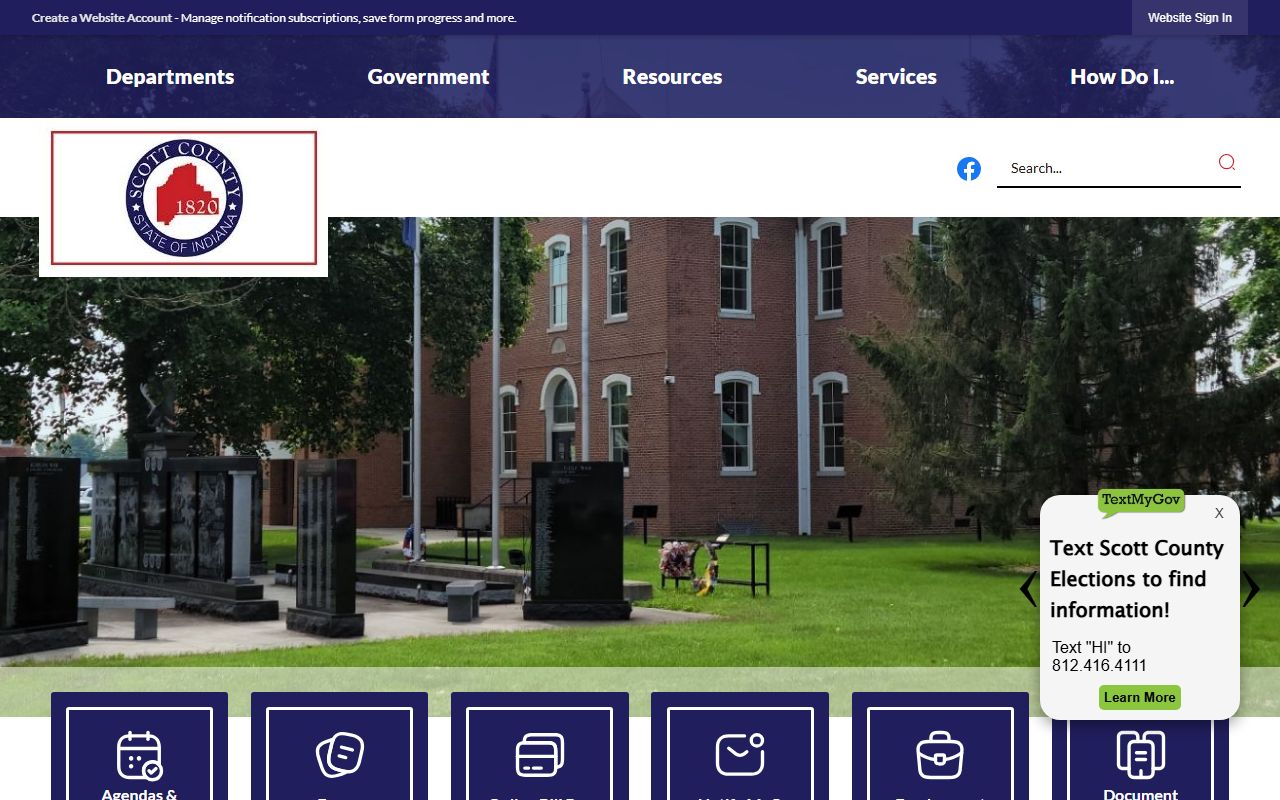
The Scott County website is the official source for current clerk contact details and any updates to courthouse services in Scottsburg.
Judge assignments and courtroom contacts for Scott County are listed in the Indiana Courts local directory for Scott County. This page is maintained by the Indiana Supreme Court's administrative office and is updated when court staffing changes.
Searching Scott County Dissolution Records
Indiana gives the public a free way to look up dissolution cases. The Indiana MyCase portal covers Scott County and lets you search by name or case number without any fee or account required. You can see case status, filing date, hearing schedule, and the docket of activity in the case. If you need to find a case number or confirm that a dissolution was finalized, MyCase is the right starting point.
MyCase does not show you the text of the decree itself or any sealed portions of a file. To get actual documents from a Scott County dissolution case, you need to work with the clerk's office. Standard copies cost $1 per page. Certified copies, which are required for most legal and financial uses after a dissolution, add a small certification fee. Requests can be made in person at Suite 120 in Scottsburg, by phone, by email, by fax, or by mailing a written request with payment to 1 E. McClain Ave., Suite 120, Scottsburg, IN 47170.
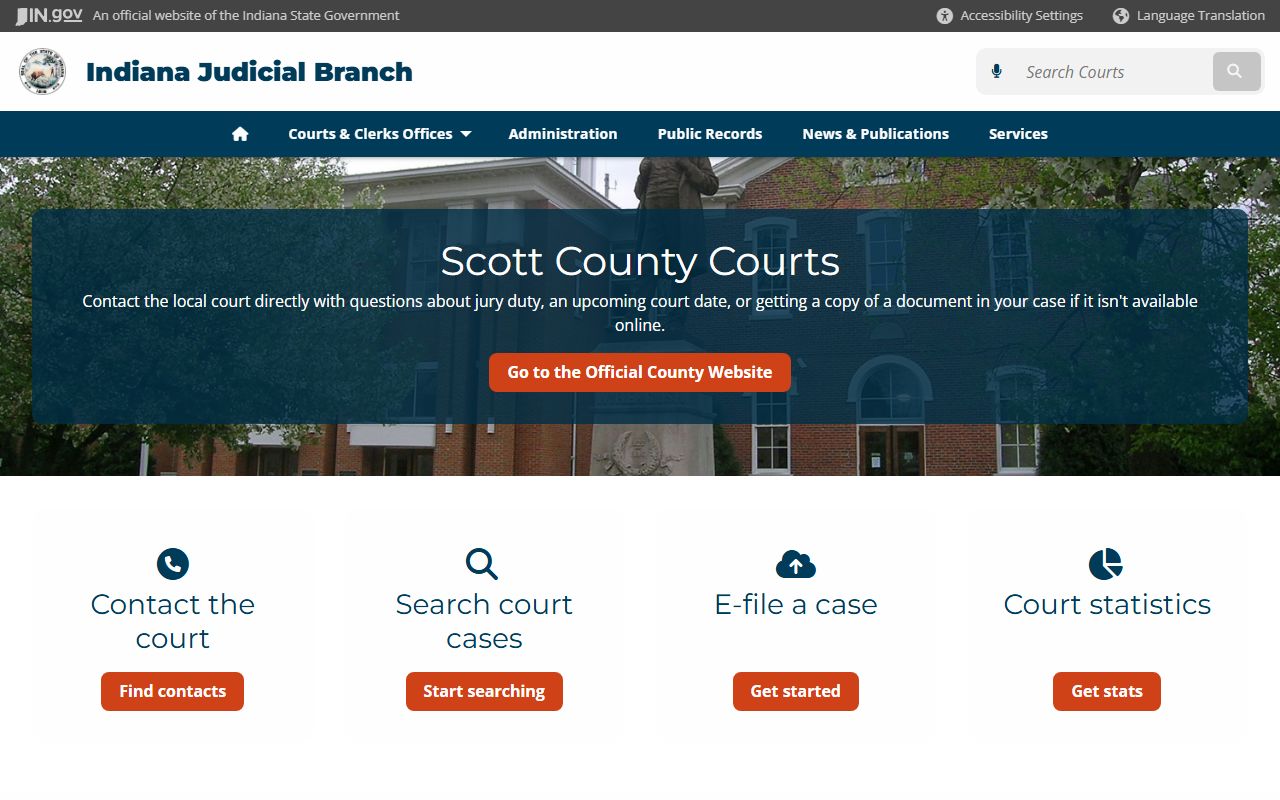
The Indiana Courts directory page for Scott County shows circuit court contacts and judge information useful when you need to identify the right court division handling your dissolution case in Scottsburg.
The Doxpop subscription service indexes Scott County court records alongside other southern Indiana counties. It can be a useful supplement to MyCase when you need to search older filings or look across multiple counties at once. Doxpop requires a paid subscription for full access, but some limited free searching is available on the site.
Mail requests to the Scott County Clerk take longer than in-person visits. Allow extra processing time, and if your copy is needed for a legal deadline, factor in the return mail time as well. Faxed requests at (812) 752-5459 can sometimes speed up the process when in-person visits are not possible.
How to File for Dissolution in Scott County
To open a dissolution of marriage case in Scott County, you file a petition with the Circuit Court Clerk at Suite 120 in Scottsburg. You submit the petition, a summons, and any other required forms. If minor children are involved, parenting plan documents and financial disclosure statements are also part of what the court requires. Call (812) 752-8420 before you go to confirm exactly which forms you need for your specific situation.
Indiana's residency requirement is clear. One spouse must have lived in Indiana for at least six months. The same spouse, or the other one, must have lived in Scott County for at least three months right before filing. Both conditions must be true at the time the petition is submitted. If you or your spouse moved to Scott County recently and the three-month mark has not arrived, you have to wait before you can file there.
Indiana uses no-fault dissolution. The only legal ground is that the marriage has broken down irretrievably. That is the full standard. No misconduct needs to be proven. No one needs to assign blame. This keeps the legal threshold for filing low, though the court process still takes time and requires proper paperwork throughout.
After the petition is filed and the other party is served, the mandatory 60-day waiting period starts. Indiana courts cannot enter a final dissolution decree until those 60 days have passed. This is a firm rule throughout Indiana, including Scott County. An uncontested case where both spouses agree on every term still has to wait. Once the 60 days are up and a settlement is in place, the judge can finalize the case relatively quickly. Contested matters take longer depending on what needs to be resolved.
The legal basis for dissolution in Indiana is Indiana Code Title 31. The filing and residency requirements are in Indiana Code 31-15-2-3. How courts divide property, including the starting presumption of equal split, is addressed in Indiana Code 31-15-7. The Indiana Courts public records guide is a practical reference for understanding how the court record system works and how to request documents from an active or closed Scott County case.
Scott County Dissolution Records and What They Contain
A dissolution case file in Scott County holds everything the court received and generated from the day the petition was filed to the day the decree was signed. The file starts with the petition and summons. It adds the other party's response or waiver, any temporary orders the court issued during the case, financial disclosures, and a parenting plan if children were involved. The final decree, signed by the judge, sits at the end.
Most people need the final decree after a case closes. It records what the court ordered. Property division. Debt assignment. Name restoration if either party asked for it. If children were part of the case, the decree or a companion parenting order addresses custody, parenting time schedules, and child support amounts. Indiana courts start property division with a presumption that both spouses get an equal share. Judges can deviate from that starting point based on each spouse's contributions, dissipation of assets, and other relevant circumstances in the Scott County case.
Scott County dissolution files are largely public record. Sealed portions, if any exist in a given case, are not accessible without a court order. Certified copies of the decree are what you need to take action after the dissolution is final. Name changes, real estate transfers, vehicle titles, retirement account divisions through a QDRO, and updates to Social Security all require a certified copy of the decree. The clerk's office at Suite 120 in Scottsburg processes these requests in person or by mail.
If you only need proof that a dissolution occurred on a certain date and do not need the full court orders, Indiana's vital records office keeps a brief summary record for each dissolution event. That summary is separate from the case file and can be ordered through the state. For older Scott County dissolution records that predate current online indexes, check the Indiana State Library genealogy collection for historical court materials.
Legal Resources for Scott County Residents
Handling a dissolution without a lawyer is possible in straightforward uncontested cases, but it carries risk. Mistakes in the petition or settlement agreement can lead to delays, rejected filings, or agreements that are hard to enforce later. Getting a legal review of your documents before filing in Scottsburg is a wise step.
Indiana Legal Services offers free civil legal help to qualifying low-income Indiana residents. They serve Scott County and can help with dissolution of marriage cases in Scottsburg. If you meet their income guidelines, free representation or at minimum a document review may be available to you.
If domestic violence is part of the situation in Scott County, the Indiana Coalition Against Domestic Violence provides confidential support, legal advocacy, and referrals to local resources. Their hotline is 800-332-7385 and operates statewide. A protective order can be filed at the Scott County Courthouse alongside or at the same time as a dissolution petition when safety is a concern.
The Indiana Courts directory is a good reference for finding judge and court contacts in the Scott County Circuit Court. Use it to confirm who is handling dissolution cases in Scottsburg and to find the right contact for any court-related question about your case.
Nearby Indiana Counties
Scott County is in southern Indiana and shares borders with several counties that each handle dissolution of marriage filings through their own circuit court clerk. Your county of residence at the time you file controls which court has jurisdiction over your dissolution case.