
Evansville Dissolution of Marriage Search
Evansville dissolution of marriage cases are filed and managed by the Vanderburgh County Clerk's Office, located in the Civic Center complex in downtown Evansville. As the largest city in southwestern Indiana with around 116,000 residents, Evansville handles a substantial number of family court filings each year. Residents who need to search dissolution records, obtain certified copies of decrees, or learn how Indiana's dissolution process works will find the Vanderburgh County Clerk's Office is the key starting point. This page covers where to go, how to search online, what Indiana law requires, and what local legal help exists.
Evansville Quick Facts
Vanderburgh County Clerk's Office
Evansville is the county seat of Vanderburgh County. All dissolution of marriage filings for Evansville residents go to the Vanderburgh County Clerk's Office. The current clerk is Dottie Thomas. The office keeps dissolution petitions, final decrees, and related court orders. You can search records, request copies, and confirm filing dates at this location.
One important detail: Evansville and Vanderburgh County operate on Central Time, not Eastern Time. The courthouse hours listed below are Central Time. If you are calling from eastern Indiana, keep the time zone difference in mind.
| Address | 825 Sycamore St., P.O. Box 3356, Evansville, IN 47708 |
|---|---|
| Phone | (812) 435-5160 |
| Hours | Monday through Friday, 7:30 AM to 4:30 PM (Central Time) |
| County Page | Vanderburgh County Records |
| Website | vanderburghgov.org |
The Civic Center complex in downtown Evansville houses the courthouse. Paid parking is available nearby. The clerk's office can assist you with case lookups and copy requests. Staff cannot give legal advice, but they can direct you to the forms you need.
How to Search Evansville Dissolution Records
Indiana provides free public access to court case records through MyCase, the state's online portal. You can search Vanderburgh County dissolution of marriage filings at public.courts.in.gov without paying or registering. The search pulls up case numbers, party names, filing dates, hearing schedules, and current status information.
MyCase does not give you the full text of orders, settlement agreements, or parenting plans. For those documents, you need to contact the Vanderburgh County Clerk's Office directly. Most cases filed in recent years are in the online system. Very old cases from the 1980s or earlier may only be available in paper form at the courthouse.
The Indiana Courts public portal shown below is the primary online tool for searching Evansville dissolution of marriage cases at no cost.
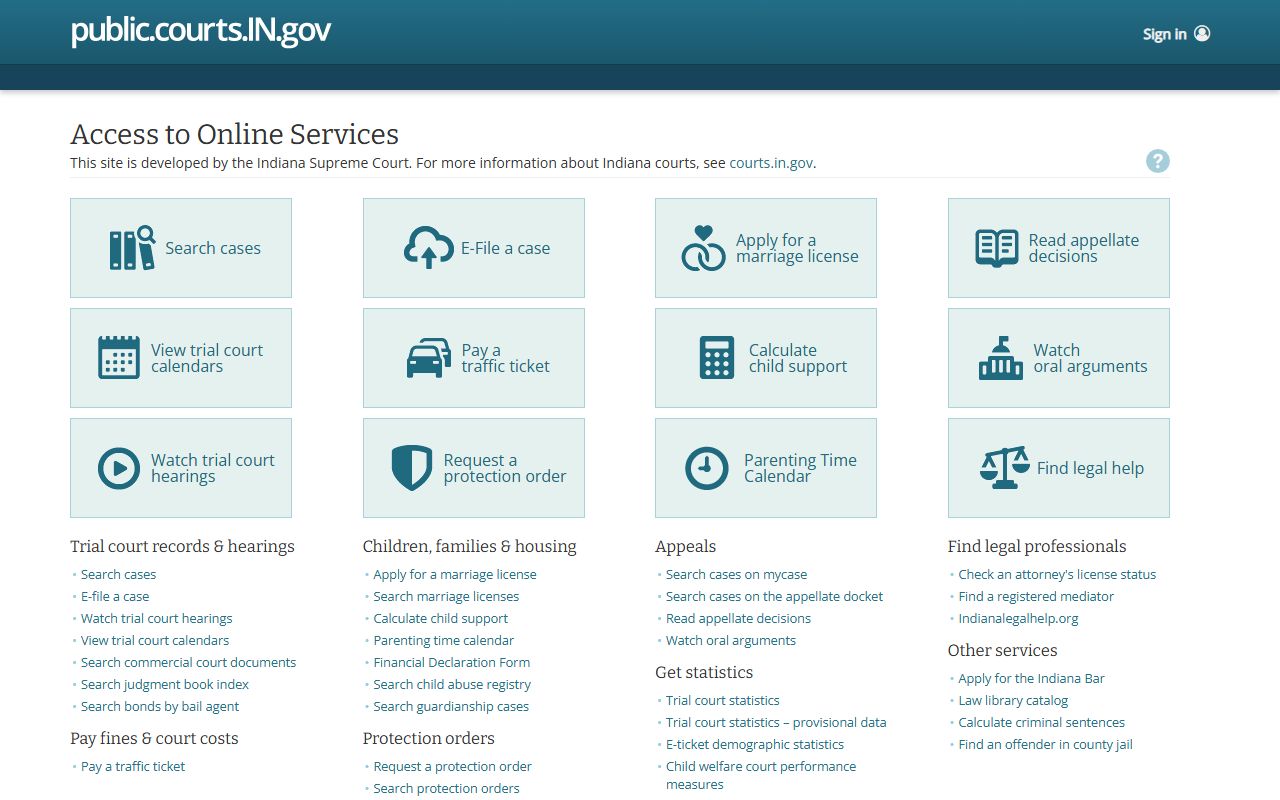
The MyCase system is maintained by the Indiana Office of Judicial Administration and covers Vanderburgh County family court filings including dissolution cases.
Doxpop at doxpop.com is a paid alternative that offers deeper indexing of Indiana court filings. It is commonly used by legal professionals and researchers who need to run broader or more detailed searches. For most individuals searching for a single case, the free MyCase portal is all you need.
You can also call the Vanderburgh County Clerk's Office at (812) 435-5160 to check on a case. Have the names of both parties and an approximate filing date ready. Staff can confirm whether a case is on file and what documents are available.
Indiana Dissolution Rules That Apply in Evansville
Evansville residents follow the same Indiana dissolution laws as the rest of the state. The governing statutes are found in Indiana Code Title 31. A few key rules shape how and when you can file.
Residency matters. To file in Vanderburgh County, at least one spouse must have lived in Indiana for six months. That same spouse must also have lived in Vanderburgh County for at least three months right before filing. If you have been in Evansville for less than three months, you may need to wait or file in the county where you previously lived.
Indiana is a no-fault state. The most common ground is "irretrievable breakdown of the marriage." You do not have to prove wrongdoing by either spouse to get a dissolution. That said, conduct can come up during property division or custody proceedings in some cases.
A 60-day waiting period is mandatory under IC 31-15-2-3. The court counts 60 days from when the petition is filed and served on the other spouse. No final decree can be entered before that window closes. Simple cases with full agreement sometimes resolve near the 60-day mark. Contested matters with children or significant property often take longer. Some cases in Vanderburgh County run six months or more before a final decree is entered.
When it comes to property, Indiana courts presume a 50/50 split of marital assets and debts. Either spouse can present evidence for a different outcome. Judges weigh factors like each spouse's income, the length of the marriage, and what each person brought into or contributed during the marriage. The court's goal is an equitable result, which does not always mean exactly equal shares.
Certified Copies of Dissolution Decrees
Once a dissolution is finalized, the Vanderburgh County Clerk's Office can provide certified copies of the decree. A certified copy carries the court's official seal. Banks, government agencies, and other institutions typically require a certified copy rather than a plain photocopy when you need to prove marital status.
Indiana sets the base copy cost at $1 per page. The certification itself may carry a separate fee. Request copies in person at 825 Sycamore St. or by mail. For mail requests, include the names of both parties, the approximate filing year, and the case number if you have it. Send a check or money order payable to the Vanderburgh County Clerk.
In-person requests are usually handled the same day if the file is on hand. Mailed requests take longer, often one to two weeks. Older archived files may require additional retrieval time. If you need copies quickly, visiting in person is the best approach. The clerk's staff can confirm current fees before you submit payment.
More information on requesting Indiana court records is available at in.gov/courts/public-records/how-to-request/.
Legal Help in Evansville
Indiana Legal Services provides free civil legal assistance to income-qualifying residents throughout Indiana, including those in the Evansville area. They assist with family law matters including dissolution filings. Visit indianalegalservices.org to apply or learn more about eligibility.
Residents dealing with domestic violence as part of a dissolution situation can contact the Indiana Coalition Against Domestic Violence at 800-332-7385 or through icadvinc.org. Local shelters and advocacy organizations in the Tri-State area serve Evansville and the surrounding region. They can provide safety planning, emergency shelter referrals, and connections to legal aid.
The Vanderburgh County courthouse has a self-help resource area where you can pick up dissolution forms and get basic guidance on the filing process. Staff there can explain the steps but cannot give legal advice. For cases involving children, retirement accounts, real property, or contested custody, working with a licensed attorney is strongly recommended. The Indiana State Bar Association's lawyer referral service can connect you with family law attorneys in the Evansville area.
Nearby Indiana Cities
Evansville is in the southwestern tip of Indiana. The nearest qualifying Indiana city is Terre Haute, located about 110 miles to the north, with its dissolution cases handled by the Vigo County Clerk's Office.